In this post, I’ll explain the meaning of the “kimchi premium,” its causes, and a website (tracker) where you can check it in real time—as simply and thoroughly as possible. I’ll also introduce trading strategies that take advantage of this phenomenon.
The term “Kimchi Premium” can be used in relation to several assets, including Bitcoin, altcoins, gold, and ADRs. However, this article will focus specifically on cryptocurrencies, including Bitcoin and altcoins.
1. What Does the Kimchi Premium Mean?
1.1) The Literal Meaning
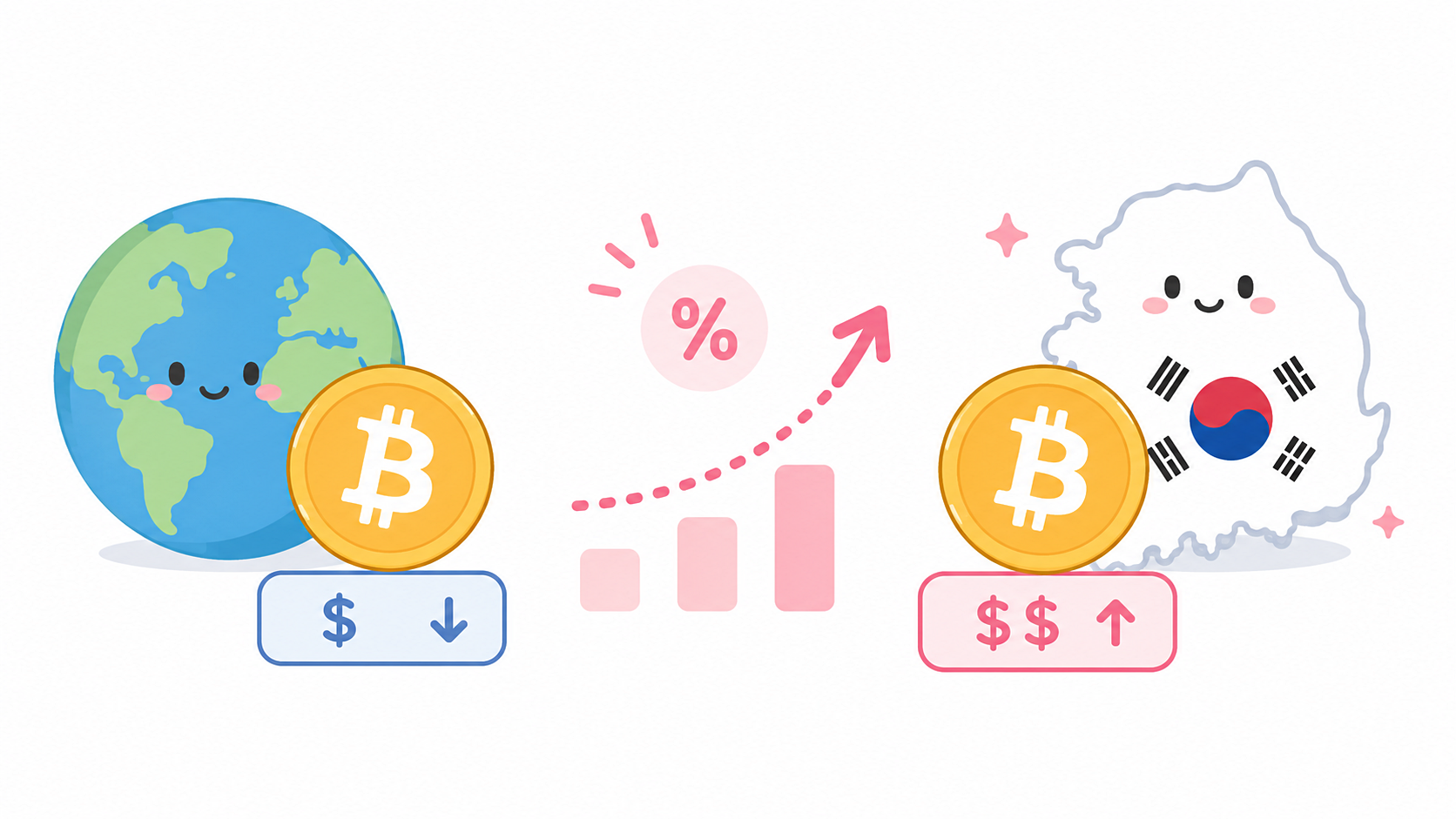
The Kimchi Premium refers to the price difference between cryptocurrencies traded on global exchanges and those traded on South Korean exchanges.
It is usually expressed as the percentage by which the Korean market price is higher or lower than the global market price. For the global benchmark, traders often use prices from major international exchanges such as Binance.
For example, suppose Bitcoin is trading at $100,000 on Binance. After adjusting for the exchange rate, the same Bitcoin is trading at the equivalent of $101,000 in South Korea. In that case, the Kimchi Premium would be 1%.
On the other hand, if Bitcoin is trading at $100,000 on Binance but only $99,000 in South Korea after adjusting for the exchange rate, the Kimchi Premium would be -1%.
A negative Kimchi Premium is also commonly referred to as a reverse Kimchi Premium.
1.2) What the Kimchi Premium Reveals
Beyond the simple price difference, the Kimchi Premium is often seen as a reflection of South Korean investors’ enthusiasm for crypto.
When crypto prices are higher in South Korea than in other markets, it usually means that local buying demand is especially strong.
South Korean investors have historically shown a strong appetite for high-risk, high-return assets. This tendency can be seen not only in cryptocurrency, but also in the stock and real estate markets.
Korean investors have also become major participants in the U.S. stock market, particularly in leveraged ETFs. Many Korean retail investors prefer TQQQ, which provides three-times leveraged exposure to the Nasdaq-100, over QQQ. Similarly, SOXL, a three-times leveraged semiconductor ETF, is often more popular among aggressive Korean investors than the unleveraged SOXX.
This risk-seeking investment culture creates favorable conditions for a premium to develop in the Korean crypto market.
Upbit, the largest cryptocurrency exchange in South Korea, is a good example. Even though it only offers spot trading and does not support futures trading, it consistently ranks among the world’s largest exchanges.
2. Kimchi Premium Tracker
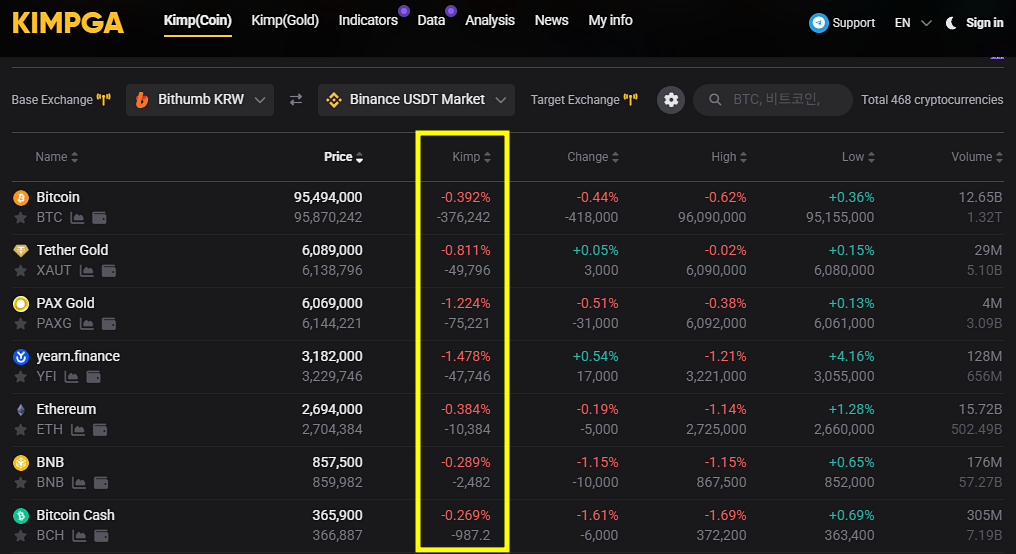
One of the easiest ways to monitor the Kimchi Premium in real time is through a website called Kimpga.
I have personally used this website during my more than eight years of investing in crypto. It supports both Korean and English.
Because the Kimchi Premium is widely followed in South Korea, many developers have created websites and apps that track it. Among them, Kimpga has been operating for a relatively long time and has generally maintained a stable service.
More recently, the website has also started displaying the premium on gold, which may be useful for investors who trade both cryptocurrency and gold.
2.1. How to Change the Language to English
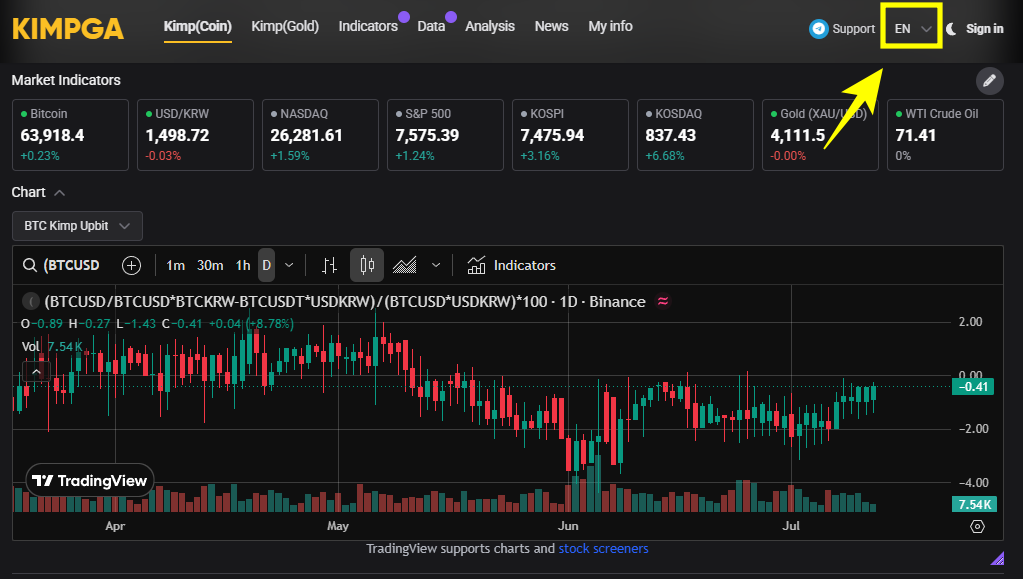
If the website appears in Korean when you first visit it, look at the upper-right corner of the screen.
You will find the language setting between “Support” and “Sign In.”
Change the setting from “KR” to “EN” to use the website in English.
3. Why Does the Kimchi Premium Occur?
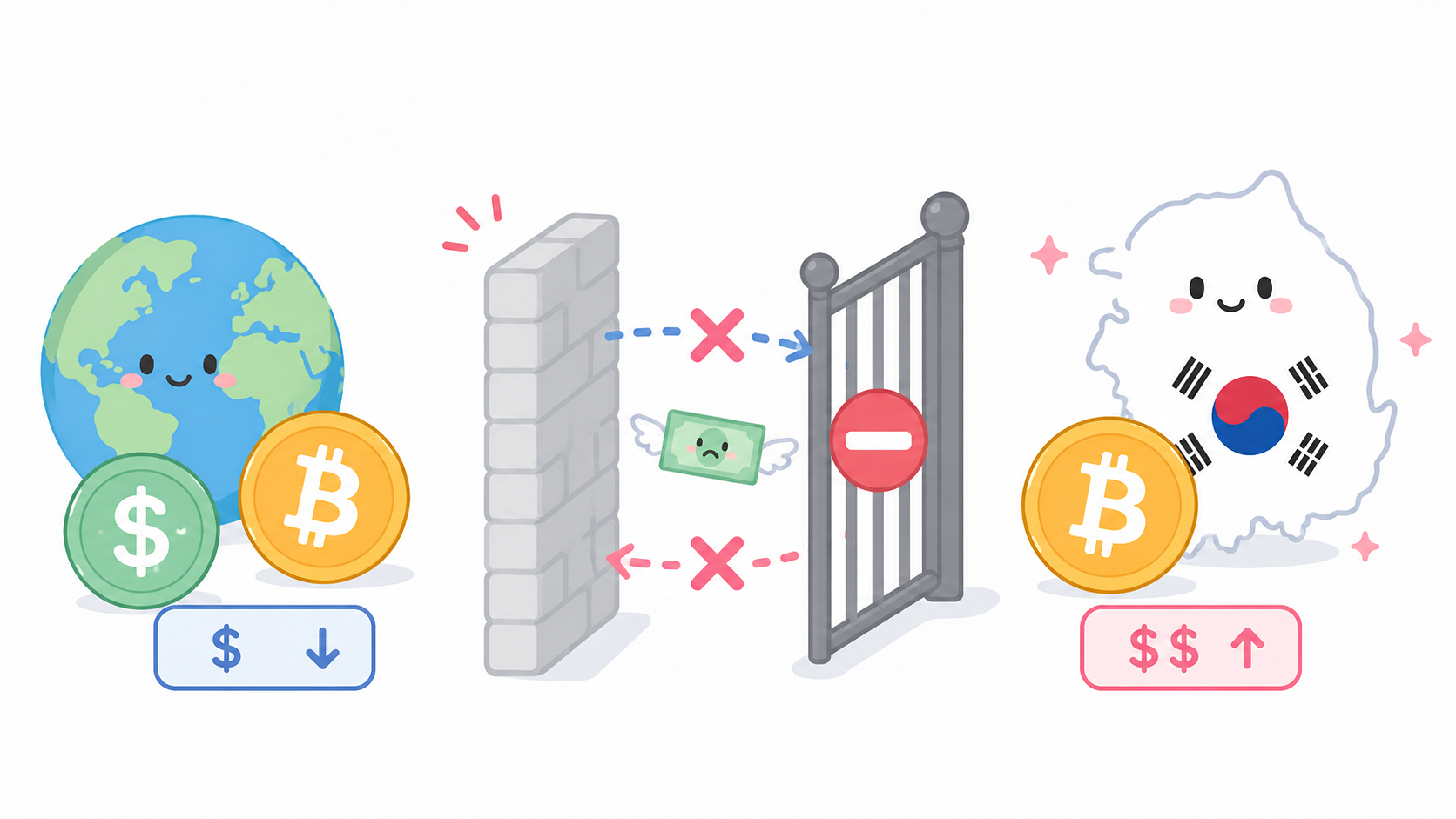
Why does the Kimchi Premium exist in the first place?
Many people assume that any price difference should quickly disappear through arbitrage. That is partly true.
Compared with the past, the Kimchi Premium is less likely to remain extremely high for long periods because more companies and individual traders now engage in arbitrage.
However, South Korea still has relatively strict foreign exchange regulations, which limit how easily capital can move in and out of the country.
After experiencing a major foreign exchange crisis in the late 1990s, South Korea introduced strict controls and reporting requirements related to overseas remittances and foreign currency transactions.
As a result, individuals may face limits or additional documentation requirements when sending large amounts of money to overseas bank accounts.
Suppose Bitcoin is trading at a 5% premium in South Korea.
In theory, a trader could buy Bitcoin overseas, transfer it to a Korean exchange, and sell it at a 5% higher price. This may appear to be a nearly risk-free arbitrage opportunity.
In practice, however, the trader first needs access to foreign currency and a way to transfer a meaningful amount of money overseas. If there are limits on overseas remittances, the scale of the arbitrage trade will also be limited.
These limitations prevent arbitrage traders from eliminating the price gap immediately. This is one of the main reasons why the Kimchi Premium continues to appear.
4. Trading Strategies Using the Premum
The Kimchi Premium can also be used as a sentiment indicator.
In general, the premium tends to rise during periods of strong market optimism, especially near the later stages of a cryptocurrency bull market. It can become particularly elevated when retail investors continue buying aggressively even after the broader market has started to weaken.
This can make the Kimchi Premium a useful warning signal.
For example, if cryptocurrency prices have already risen sharply and the Kimchi Premium suddenly reaches an unusually high level, it may indicate that speculative demand in South Korea has become overheated.
In that situation, traders may want to reduce risk, take partial profits, or tighten their stop-loss levels rather than continuing to chase the market.
The opposite situation can also provide useful information.
During prolonged bear markets, the Kimchi Premium may fall below zero and remain negative for an extended period. A persistent reverse Kimchi Premium may reflect weak local sentiment, low retail participation, and widespread pessimism.
While this does not guarantee that the market has reached its bottom, it can help traders identify periods when market sentiment is unusually depressed.
Therefore, even if you are not based in South Korea, monitoring the Kimchi Premium can still be useful. It provides a real-time view of investor sentiment in one of the world’s most active cryptocurrency markets.